Showing posts with label Laura Brent. Show all posts

Tuesday, July 23, 2013

Sage and Sky

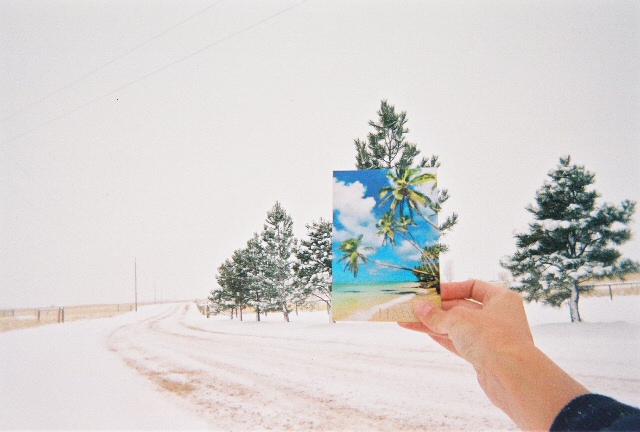
Sage and Sky, pinhole photograph by Laura Brent, 2013
Summer is a time for traveling, and long road trips are the perfect opportunity for uninterrupted thoughts. The southwest is the perfect location for these wanderings, with its brilliant light and expansive air. I feel refreshed and energized having recently returned from those magic desert places. The ideas, mulled over with the miles, have incubated and are ready to come forth through new works.

Road Trip, pinhole photograph by Laura Brent, 2013
 The journey is long, an unending path. The quest - for beauty - in the eye, the mind, and the heart.

American Beauty, pinhole photograph by Laura Brent, 2013
 "To calculate on the unforeseen is perhaps exactly the paradoxical operation that life most requires of us."
"...one does not get lost but loses oneself, with the implication that it is a conscious choice, a chosen surrender, a psychic state achievable through geography"
          - Rebecca Solnit, A Field Guide to Getting Lost

Tommy Knocker Trail, pinhole photograph by Laura Brent, 2013


Why wander? Will the destination offer up a respite? What discovery will come from an aimless ambling? Looking for the happy happenstance, the quirky coincidence, the surprise prize. What spirits are leading the way? How well do you know them? If you are aware, you can almost see them. And remember, at the end, we all become the dirt of the roads, forever left in the rear-view mirror of life. I plan on leaving something behind.


Friday, June 14, 2013

Transfer of spaces, objects, ideas,


Laura Brent, untitled photo-gram,2011


A time of change brings with it a great opportunity to move in a new direction, and with a stronger intent. The work that will come from this transition will be interesting to see, I am excited to witness its unfolding. The new location adds the ability to work without distraction or intrusion. The security that comes from this will bring an adventurous spirit to the creative work. The timing of this beginning, its happening in company with my audience during the studio tour, will forge a deeper connection with the work. My dedication to 'getting it right' is bolstered in these actions.

With these ideas I forge ahead into the next big event, the Fort Collins Lincoln Center annual Studio Tour. I participated in the tour many years ago, when it was organized by the art museum, and it was not a great experience for me. It was not a particularly high point of my career. I was still learning. This year, already, has been a great experience. Partnering with Jennifer Davey has kept my spirits up, and we encourage and challenge each other to make it an enriching event for our audience. We are offering a special chance for collectors to forge a deeper connection with artists, an opportunity to witness the creative processes. We want to draw the viewer into our experiences. We will each offer something for the visitor to do, a chance to be an artist with us, and create something unique to themselves.
The studio tour is June 22 and 23, from 10:00 am to 5:00 pm each day.
The exhibition featuring one work from every participating artist, opens June 14th with a reception from 5-7 pm at the Fort Collins Lincoln Center Gallery. The exhibition continues through June 29th. Gallery hours are Tuesday - Friday, 10-6 and Saturdays 12-6. There will be extended gallery hours during the tour, June 22 and June 23, 10-6.

Thursday, April 25, 2013

...a reflective look back.

American Beauty
Valhall Arts has come a long way in its last 5 years of existence. Like a toddler, there were the awkward moments, and mistakes, but overall it has been a fun and successful run. The growth of my photography has only begun, and I feel like a child exploring, as I make my way forward in my practice.

With the probability that the current situation is coming to an end, this month I offer a Retrospective, opening Friday May 3rd, 6-9 pm. The exhibit offers a look back at past exhibitions, and the opportunity to see the progression of my work. The gallery began with straighforward photographic exhibitions, showing the work I did while talking classes at Front Range Community College. I had good luck with the fact that the local educational institution was home to some world class instructors, and my passion for photography and the arts was ignited.

Even as I opened my first few shows, I knew I would grow tired of the standard presentation of photographs presented under glass with white mats in black or white frames. From the very beginning I was more interested in experimenting with the medium, expanding the ideas of what a photograph could look like and how a photography exhibition could be presented. I was interested in engaging my audience, really inspiring them to interact with the art works, bringing in relational aesthetics, and other contemporary practices into my projects.

Come see the transitions and changes that occurred over the five plus years at Valhall Arts.
More details and images can be found on my website, http://www.valhallarts.com.

Thanks! Hope to see you at the receptions May 3rd and June 7th,
                                                                                         ~Laura Brent


Monday, January 21, 2013

New Pinhole Project

Laura Brent; pinhole photograph, silver gelatin contact print


I have started a new pinhole project, re-visiting an old series I shot back in 2008, "Toyland", combining it now with the pinhole camera. Using vintage toys, dollhouses, and handmade dioramas, I create small stages, positioning my 'models', evoking a possibly frightening narrative. The imagery is a bit reminiscent of film noir, and the viewer must look closely to determine what they are seeing. The objects pictured are easily confused with reality. The small size of the camera allows me to obtain a vantage point unlike any from the previous project. Often I am shooting blind, placing the camera into the scene, at a location that I am unable to witness with my own eye. The project will debut at Valhall Arts February 1, 2013. Stay tuned for more details.

Tuesday, January 15, 2013

New site for my pinhole photographs

Sunrise Over Hernandez, Laura Brent

As a way to streamline the viewing of my pinhole photographs, I have created a new website.
Visit laurabrent.org to see them in all their glory.  Please take a look and let me know what you think.

Tuesday, October 2, 2012

SKY HIGH


SKY HIGH ~ Artist's reception December 7, 2012, 6-9 pm

“The clouds were there for everyone.” -Alfred Stieglitz

“The photo can optically replace its object to a certain degree. This takes on special meaning if the object cannot be preserved.” –Bernd and Hilla Becher


SKY HIGH is an exhibition about beauty. The presentation is a typology of skyscapes. The photographs, a catalogue of our skies, document the variety of shapes, forms, colors, and textures, seen in the clouds above us. Each viewer sees a unique picture, the personal experiences and histories affecting the truth of what the viewer sees. The collection, and its presentation, is founded on historical precedents.

The subject of clouds was much studied by one of photography’s, and American Modernism’s, pioneer, Alfred Stieglitz.  His series, ‘Equivalents”, was produced later in his career, (most were made between 1925-1935) and were purely lyrical abstractions, intended to function evocatively, to elicit emotions in the viewer. The photograph is a metaphor, the cloud shown in the picture, is more than the ‘thing’ pictured, but primarily a ‘function’, a device, to generate a feeling in the viewer. (Equivalence: The Perennial Trend. Minor White, PSA Journal, Vol. 29, No. 7, pp. 17-21, 1963)

1923. Gelatin silver print, 4 5/8 x 3 5/8" (11.8 x 9.2 cm). Alfred Stieglitz Collection. Gift of Georgia O'Keeffe. Held in collection at The Museum of Modern Art, New York


Bernd and Hilla Becher were married German photographers who catalogued the existence of many industrial buildings, and other architecturally interesting structures, and presented them in the grid form. Their motivation was to create an historical record of this "nomadic architecture which had a comparatively short life -maybe 100 years, often less, then they disappear. It seemed important to keep them in some way and photography seemed the most appropriate way to do that." (quote by Bernd Becher)

Bernd and Hilla Becker, Installation view

What is more transient than the ever-changing vista above our heads? How often are you aware of the beauty above? If we take the time to look, the beauty is there for everyone. Remember to notice, and do not lose this treasure, the ability to find beauty.

Exhibition featured at Valhall Arts, please visit the website for more details. 

Soundscapes selected by Chris Reider,  ambient sounds and experimental music, all part of creative commons, and free for anyone.

Photograph by Laura Brent, 2012


SKY HIGH, 28 Photographs by Laura Brent, installation view

Thursday, May 31, 2012

The Mystery Project


Object, by Laura Brent. Wood cup lined with velvet on typewritten card. 2012
I just completed another Art House Co-op project, (My seventh! I love these guys, so inspiring!) called The Mystery Project, where I created an artwork to be left in a public space to be found by a stranger.  Again, this was an inspiring project and really got me thinking on my art making, the objects I create (or not, as the case may be, as a conceptualist), and my audience.

I was sent a kit with supplies to guide me in my creation. Included was a 'theme' and a free Canary Yellow Prismacolor fine art marker. My theme, "Things and the people and places using them" was fairly wide open, and became my main inspiration, as I am often thinking on objects in relation to my art making and how one assigns meaning and value to objects. The marker, with two differently sized, flexible tips, while nice and bold, was fairly uninspiring. The color did not 'pop' for me, and drawing is more of a private activity for me, one that I use in working out my ideas, but that is not my finest skill, and not the primary material presented in my artwork.


Thinking conceptually, I considered what would be considered a pinnacle object in our contemporary society. A cell phone or computer? Which object carries with it the most significance? Did I want to choose some obscure object, or something common to all? I continually kept coming back to Meret Oppenheimer and her Object, having seen it in person at the MoMA.

Object, Meret Oppenheim, 1936
Here was a common object, a cup, altered in such a way as to make it unusable, offering a commentary on how we perceive objects we use and come in contact with every day. By adding the foreign materials, the useful object become useless, converted to art, a surreal object with a higher purpose.

This was what I wanted to create. The cup signifies a communal meeting, an object used to nourish our bodies, and something common at social gatherings.  Using found materials, I altered a wooden cup, lining it with red velvet, and it became something else, a unique special object - art.

I felt badly not following the rules designated for the project, but it was also stated that the work  could take any form, so I went ahead with it.  Expecting the work to be generally misunderstood, (see the previous posts regarding my audience...) I decided to leave it in one of Fort Collins' best coffee house/book stores, The Bean Cycle/Matter Books, hoping that the person who encountered it there would have a basic knowledge of contemporary art, or at least a curiosity to explore. (i.e. book lovers.) The colorful title of the book pictured nearby was the impetus for my final choice of location.

My Mystery Project, installed in its location, near the art & photography books.

The work's reception is a mystery to me. I will never know who sees it, who takes it home as their own, and how it is perceived. But this is part of the adventure of art making, putting one's work out in the world, it is no longer mine, and the public can do with it what they may. It was not easy to leave, as I was quickly becoming attached to it, as I enjoyed its tactile beauty. But, I slyly set it upon the shelf, pretending to look at books, unnoticed by the few folks working nearby on their computers.  Perhaps it may still be there when I return one day. If not, I hope it finds a place where it is appreciated and enjoyed, as I did its creation.
Another view of the work.

Detail of typewritten card.

Wednesday, May 23, 2012

Duchamp, nothing and an already made artwork

Every summer, I take time off from the gallery life, and take a sabatical from the exhibitions at Valhall Arts.  Instead, I leave behind something for my visitors to see.  Something that is nothing.

Last summer it was an installed hole in the ground, dug in the middle of the gallery, an obvious falsity, (and Andy Goldsworthy reference)


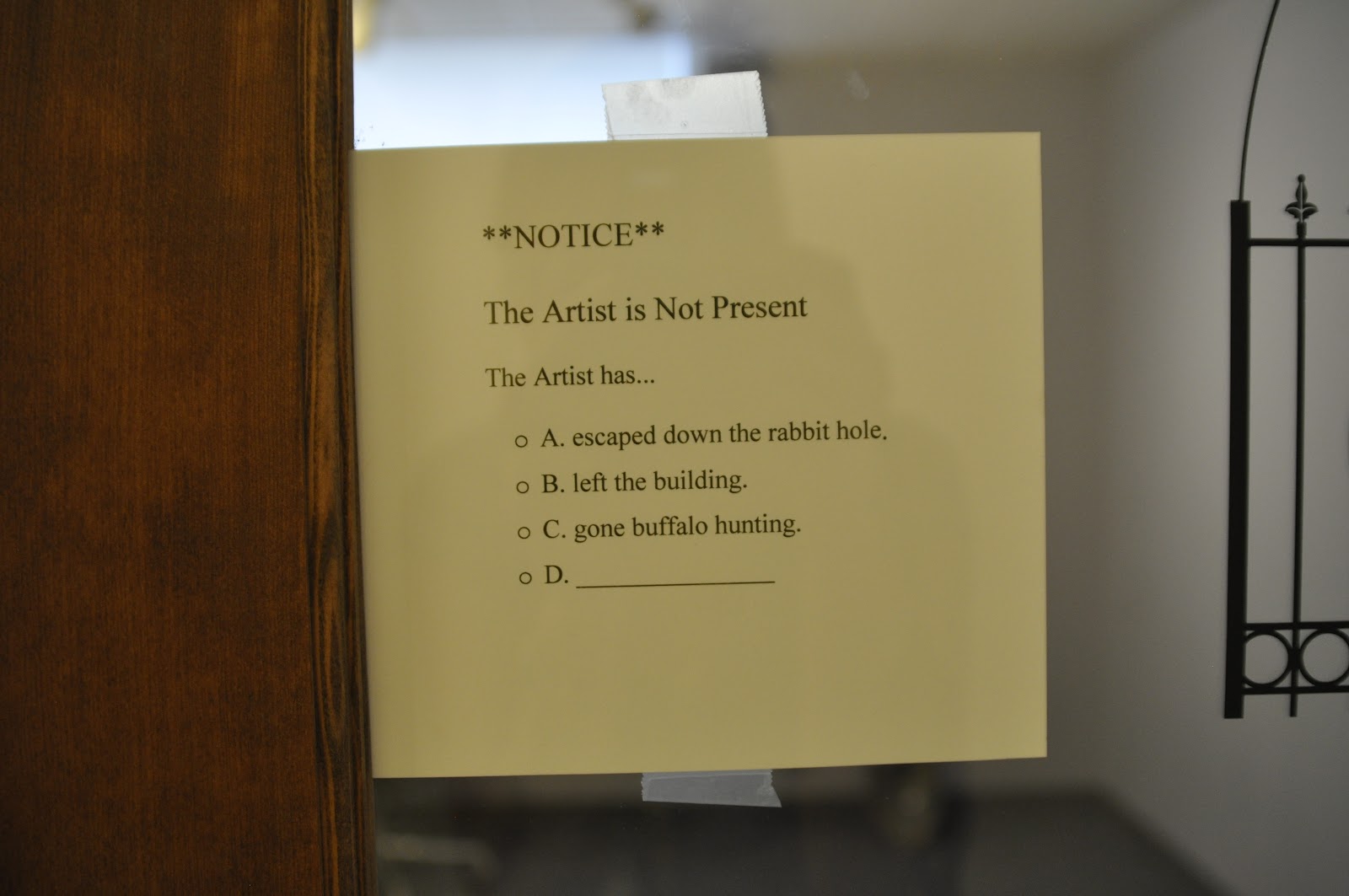
I presented it as a joke, but also a truth.  The title, The Artist is not Present, was a direct reference to Marina Abramovic's performance (that I went to see) at the MoMA, and the shovel left in the space as a nod to Marcel Duchamp (specifically his "In Advance of the Broken arm"). The multiple choice question didactic was a way to playfully engage the audience, while dropping clues to some of my favorite popular cultural ephemera, as well as a statement of my feelings toward the reception of my artwork by my local audience. It's a construction of an environment, one that the audience was excluded from (only able to look through the window in the closed and locked door), using common objects, symbols, and cliched ideas.

This year I have installed something along this vein, however at the this point in my work, I have reached a state of utter disregard for my local audience. I feel like after the 4 years that Valhall Arts has been open, I have taken them as far as they are willing to go in regards to viewing and thinking about contemporary art. Their responses are baffling and frustrating, and mind blowing in their ineptitude. I am instead focusing on my ideas, my work, and marketing it to a broader audience, beyond my neighborhood, hopefully for viewers who care to take the time to understand it. This situation could be considered a brief re-enactment, an homage of sorts, to Duchamp and his behavior at the end of his career when he stated that he was no longer going to make any more art, and instead, just play chess. (Image below is Duchamp's window display for Andre Breton's  Arcane 17 at the Gotham Book Mart, 1945)


Time would reveal that this was a sort of performance art in itself, as Duchamp was busy for many years creating his final grand artistic gesture. (The creation of Etant donnes -- link via ToutFait.com, is to an animation by Robert Slawinski, and involves the five following unaltered works by Duchamp in the order in which they are listed below:

Window Display for Andre Breton's Le Surrealisme et la Peinture, 1945
Given: Maria, the Waterfall, and the Illuminating Gas, 1947
Study for Given: 1. The Waterfall / 2. The Illuminating Gas, 1947
The Illuminating Gas and the Waterfall, 1948-49
Given: 1. The Waterfall / 2. The Illuminating Gas, 1946-1966)

I want to leave my audience to wonder where I've gone, as I go out into the world to enjoy all it has to offer. I leave them only a tiny clue, easily overlooked, a QR code to scan, itself a bizarre object unique to our contemporary digital culture. I wave a fond farewell, as I bid them  to "piss off!".  To those curious few who make the effort (and have the smart phone ability) to scan the code, a surprise. See what it will bring? Yep, "Nothing Here."


Tuesday, April 10, 2012

Giving it all away!


My new installation is a very subtle and complex work of art. Many who visited the opening were confused and did not understand the meanings in the work. It was very common for people to rush in and out, only spending a short time looking at the installation. There was often a lack of serious consideration given to the artwork, rarely was any time taken to just experience the environment, taking in the entire installation, absorbing the myriad of sensory stimuli in the space. I was often asked, “What’s it about?” as the visitor just wanted the quick answer, for me to simply tell them my ideas. To do that would defeat the making of the art, the delivery of my ideas through beautiful environments. When I create an installation, I compose the entire environment, directing the visitor’s experience, so it is somewhat disrespectful when a visitor does not take the time to actually look at what I’ve done. Why are you here? I do not understand this mentality, this lack of attention. I assume these are folks out on the First Friday Art Walk, so they must be interested in art. They may just be unfamiliar with, or unaware of, how to look at art. It appears that there is a lack of motivation to investigate, to explore, engage and enjoy strange or confusing artworks. Where is the creative curiosity? Perhaps a person’s ego is bruised by this confusion, experiencing a feeling of stupidity because they do not understand, and this puts them off. But, do not make the mistake of confusing the subtlety of the work as some high brow, over intellectualized “art-speak”.  My ideas behind the work are persistent human emotions, issues and conditions common to all, and if the viewer would only take the time to experience the work, in its entirety, they would arrive at the answers themselves. Any work of art, will, of course, always be an individual experience, so my ideas are not necessarily the ones the viewer will arrive at, but once an installation is truly experienced, the messages and emotions and thoughts created in the viewer become valid as well. Being in the west, in the lesser populated heartland of our country, there is a bit of a disconnect with the rest of the contemporary art scene found in major cities (NYC, LA, Chicago), so the reactions of my public does not surprise me. It is confounding though. (I will digress here no further, for more discussions see other &/ future posts.) So, to aid in the reception of my work, I will explain it, in an attempt to educate my audience, and perhaps, some will be intrigued enough to want to see it (again).

Moving Pictures, Take Two
Meditations, 2012

 The space is small, sparsely furnished, with minimalistic objects and sensory stimuli. There is an intimate feel of an alter space, with the dramatic black curtains on each side of a white cloth panel in which the short film is playing in a loop. The white cloth cascades out into the small room in a wrinkled watery stroke. A small battery operated candle flickers artificially in the middle of this ‘stream of cloth’. The edges are defined with two white ‘columns’, haphazardly leaning against the walls. Opposite the video is a sterling silver necklace with a baby shoe charm, and upon further inspection, it is revealed to contain the artist’s blood. This small object is lit with a spotlight to accentuate its importance in the installation, its placement opposite the video purposefully used to contrast the ready made object with the created object. There is also a small table with a simple tin tray with bread and small cups filled with wine. There is a small didactic, similar in size to a prayer book, listing the installation materials*, and stating to “please use reverence” if one is going to imbibe in the proffered bread and wine as a sacred sacrament. This is the single sign directing the visitor to the importance of their interaction with the work, or not, as the case may be, and to be aware of the reasons behind their choice.


The short film is a digital collage made with an iPhone camera, using an 8mm film application, and has a vintage feel, being black and white, dust scattered through out and a jumpy, frame skipping look. This artificial aged feel is purposeful, used to instill a sense of nostalgia in the work, a timelessness, and something coming from long ago, giving the work the appearance of traveling through time, yet actually being a false indicator, made as is was with a modern device.  The 3 minute film begins with a blank shot, a rhythmic beating of shadows against a white background, really bringing again, the artificial aging, and digital creation, with its ‘dust’ and ‘projector’ noise to the viewers attention. The image is what one might see upon waking in the room, opening the eyes, beginning the day, the bare ceiling filling the entire frame, with only a bit of the wall grounding the imagery like a landscape. The next scene is a quiet shot of a stark and empty table and chair, cast with a dramatic black shadow, cutting the round table not quite in half. This could feel like a lonely time, but my intention was one more of reflection, and meditation (thus the name, Meditation 2012, part of the Moving Pictures series). The round lines in the chair and table contrast with the sharp straight line created by the shadow on the table. There is an interrupting triangle of another shadow, just breaking the edge of the frame, with other straight shapes distracting the viewer. The stillness and length of the shot, the slight, slow movement in a circle, all are commentaries on the quietness of the moment, perhaps a morning ritual, or a time ‘at the table’, a place for sustenance.  The last shot of this scene is one from a distance, and we see the doorway, and the intersection lines forming a cross in the reflections on the French door. The doorknob a round point in the frame, moving slowly in and out to draw the viewer’s attentions, foreshadowing what’s to come.

Midway through the film the scene cuts to a shot looking out the window, now the dominant shape is the square, the strong white lines creating multiple crosses, the ‘outside’ is introduced, as the view looks out the window. There is a very subtle, slow drawing in and out, almost peering out, but then drawing away, moving forward and back, like a breath; it is a preparation of sorts, a conscious change of thought from the previous scene at the table, one of the ‘self’, and now is shifting to thoughts of the ‘other’. This is continued in the next scene shift, taking the viewer on a slow progressive journey from inside the home, out into the community. However, there is a reluctance, a hesitancy, even as the pace of the film begins to pick up. The scene is that of a closed door, with its fairly uninviting feel, shot from the distance as it is, and the noise taking on a low volume roar of space. The stagnation is broken in the last 30 seconds of the film by a dramatically different scene with movement, as the viewer is ‘walked’ out of the courtyard. We see again the windows, but from the outside now, and only in passing glances. The strong white lines of the columns as they pass by are symbolic of the daily duties, and responsibilities of daily life, the scene ending with a pan to the sky, a symbolic ‘going out into the world', and finally the film culminates in a final still view of the portico of a church, linear columns holding up gently curved archways, and a reverent statue of St. Francis barely discernible in the shadows, signifying an arrival, a finding of ones place, a relaxing celebration with the first obvious sounds heard, those of birds, and with it, a peaceful feeling of freedom finally arriving, as the film washes out.


The overtly religious symbols I use in the film are there to direct the viewer to spirituality, but it need not be necessarily Christian; it can be any sort of spiritualism. The work was opened on Good Friday, probably the holiest day in the Christian faith. I reference the Christian story of God’s giving of the Son with the repeated use of  the iconic visual symbols, the cross, and communion cups, accentuating the sacrifices that were made for the sins of humankind, and the forgiveness that is given through God’s gesture. The ritualistic re-enactment through communion, is highlighted with the objects associated with that ritual, also offered as sustenance and refreshment, and an offering to the visitor. The white cloth on the floor is a symbolic of the parturition, and Mary's sacrifices she was required to make. I wanted to spotlight the sacrifices we all make, and as a symbolic gesture of my own, drew my own blood for the work. Another message in the work is also one of forgiveness, something everyone needs, even giving grace to ones self. We are all lost children, who suffer through our own sins and mistakes. We all sacrifice ourselves as adults for our own children, or others, spilling our own blood. These things I touch on through the purposeful use of the particular objects in the space. I also point out that this is not a holy space, though the obvious artificiality of some of the objects. The fake old style modern technology used to make the film, the candle not being a real candle and the columns not really there, all remind the viewer that it is a work of art and not a sacred place, as it can be anywhere. It is offered as an opportunity to be used as a spiritual space, but more importantly I want the viewer to take away enlightenment within themselves, about sacrifice, forgiveness, and finally acceptance and peace.

*Installation Materials:
3 minute 7 second looped black and white video
Black and white cloths
White columns
Bread and wine offering
Silver necklace with baby shoe charm
Candle
The artist's blood

Thursday, March 1, 2012

ArtHouse Sketchbook Project Process, Part 3

This is the third post in a three part series explaining my processes in creating my sketchbook for the Art House Co-Op, in Brooklyn, NY. (Sketchbook Project 2012)


Here is how I re-bound my sketchbook:

First, I started by punching hole in every leaf, and arranged the pages in four groups of four pages each, with a fifth group being made up of the single photograph. I arranged them, and cut the edges even, the corners rounded.


Due to the thickness of my five sections, I decided to make three holes in the cover, planning to use the outer two holes twice and the center one once. I did not want to make 5 separate holes, because I did not want the book to be too thick.


Before sewing, I waxed the binding thread by pulling it through a block of bees' wax. I left plenty of extra thread to tie my knots, and began at the front top outer hole, and wove back and forth through the punched holes in the section and the cover, then back up adding the second section. Once at the top again, I pulled everything tight and tied a knot to secure it.


I continued on, adding the sections one by one, sewing up and down, in and out of my punched holes, until all were tightly in place.


I finished by tying a a secure knot


I added a strip of book binding tape to cover the outside threads, being sure to leave the bar code visible, and voila! It was finished.

Seeing it in its completed state was quite a rush of emotions. I was excited and proud at the results, happy even with the failures as it was a testament to the adventurous process I had undertaken. I hastily took some quick snaps of the project, just in case it was lost in the mail, and packed it up and shipped it off to the Art House Co-op. I plan to visit it sometime on the tour this year, or at its permanent home at the Brooklyn Art Library.

Saturday, May 28, 2011

The Artist is not present.


The Artist has....
A. escaped down the rabbit hole.
B. left the building.
C. gone buffalo hunting.
D. __________________

Installation featured at Valhall Arts for the summer.
Stop by the Plaza level of the Fort Collins Museum of Art to see it.
(201. S. College Avenue, Fort Collins, CO)

Thursday, April 14, 2011

"After Niepce"


This image was created by Laura Brent, using color film and a pinhole in a body cap on a Nikon FE2. The imagery is evocative of Joseph Nicephore's (Niepce) 1826 "View from the Window at Le Gras", the first photograph ever made. It is held at the Harry Ransom Center at the University of Texas, in Austin.

In this day and age of digital cameras, and high-tech methods of gathering and printing photographs, Brent enjoys getting her fingers wet with the photons, experimenting with the pinhole medium. The image was captured in Santa Fe, NM, and the film was developed in Durango, CO at Pennington Photo, a camera store that has been in operation since 1906, and plans to close at the end of April. This work is in homage to the historic makers and methods, and a gesture that these vintage processes are still a valid art form.

Tuesday, March 8, 2011

New Work - A Million Little Pictures: Photomobile


This is an image in my project for Art House Co-Op in Brooklyn, NY, "A Million Little Pictures: Photomobile". My theme was 'the meaning of a photograph'. Shot in Colorado in February 2011 by Laura Brent.

Friday, January 7, 2011

Expansion Opens at Valhall Arts


Opening Tonight, January 7, 2011, with a reception from 6-9pm, Valhall Arts has expanded! Tonight will feature a video installation by Laura Brent, "Moving Pictures", As well as the exhibition organized by the young curators from TR Paul Academy of Arts and Knowlegde, "Religions Around the World".

Stop in to see the new space, say hello and toast the New Year! This is also the closing reception of the TPAAK Young Curators, "Religions Around the World", so it will be the last chance to see this great show.

Visit http://www.valhallarts.com for more information.

Saturday, October 23, 2010

The American Dream: A Juxtaposition


Just entered my video into an exhibit in Chicago.
Below is my statement:

How does one define the American Dream? Is it the attainment of a collection of priceless objects, living the lavish lifestyle of wealth and fame? Or is it attained through our accomplishments? The often touted goal of "having it all", is this possible? How does one maintain the delicate balance of family, career, and personal accomplishments, without losing the personal sense of themselves? True happiness comes from the intra-personal relationship with one’s self, and the inter-personal relationships with others, through the interactions of a small community of close contacts. Ultimately, we are defined by our dreams. The American Dream is a personal institution, one that suffers in our disconnected, wired world, with its fast paced modernity. We offer only passing glances to others as we go about in our media focused consumerist culture, missing the greater things of value, a true awareness of the moments, and real connections. Only through living a valid life, doing what one loves, contributing to civilization in a lasting way, and engaging with others, can the American Dream be realized.

Thursday, October 7, 2010

New Exhibit in the Works


The new exhibition planned for November is called "Moving Pictures". It is an installation with two video works by Laura Brent, that look more like photographs. It is an experimental piece, and the videos, in which very little happens, will make the viewer wonder about what they are seeing.
The title, used before in a 2002 exhibit at the Guggenheim (NYC), included works by Marina Abramovic, Vito Acconci, Kara Walker and Shirin Neshat, among others. The exhibit explored the affects of this new reproducible media in art making, it ability to render visible conceptual concepts and questioned the supposed objectivity of representation in itself .
This small solo presentation could never attain the drama of the museum's show, but I want the viewer to gain a sense of themselves, their youth, and their mortality. This piece follows my ongoing study of how we see things, how our media saturated culture has affected our way of looking, and visually experiencing and interacting with our environment. It is similar in feel to Brent's previous exhibits, Public Practice, and "pinching the light fantastic".

Monday, August 30, 2010

New Photographs by Laura Brent, opens Friday!

Putting together the new exhibit of my latest photographs, opening this Friday, Sept 3, with a reception from 6-9:00 p.m. The works included feature new images in two previous series, both the "White Dress" and "Toyland". Also, I will be showing some more personal photographs, images taken of my family and our times spent over the summer. To exhibit these intimate family pictures is challenging for me, as I am a very private person and try to keep my professional and personal images separate. The quality of the images is inspiring me to share the work with my audience. I only hope they will enjoy them as much as I do.
Also included in the exhibit are some Polaroid images, both new and old, and digital images formed in the 'polaroid' style, using the latest technologies.
Photo Credit: "River", taken in Fort Collins, Colorado, 2010 by Laura Brent. All images copyright of the artist.